Gauge theory
Mathematical formalism
Gauge theories are usually discussed in the language of differential geometry. Mathematically, a gauge is just a choice of a (local) section of some principal bundle. A gauge transformation is just a transformation between two such sections.
Although gauge theory is dominated by the study of connections (primarily because it's mainly studied by high-energy physicists), the idea of a connection is not central to gauge theory in general. In fact, a result in general gauge theory shows that affine representations (i.e. affine modules) of the gauge transformations can be classified as sections of a jet bundle satisfying certain properties. There are representations which transform covariantly pointwise (called by physicists gauge transformations of the first kind), representations which transform as a connection form (called by physicists gauge transformations of the second kind, an affine representation) and other more general representations, such as the B field in BF theory. There are more general nonlinear representations (realizations), but are extremely complicated. Still, nonlinear sigma models transform nonlinearly, so there are applications.
If there is a principal bundle P whose base space is space or spacetime and structure group is a Lie group, then the sections of P form a principal homogeneous space of the group of gauge transformations.
connection (gauge connection) define this principal bundle, yielding a covariant derivative ∇ in each associated vector bundle. If a local frame is chosen (a local basis of sections), then this covariant derivative is represented by the connection form A, a Lie algebra-valued 1-form which is called the gauge potential inphysics. This is evidently not an intrinsic but a frame-dependent quantity. The curvature form F is constructed from a connection form, a Lie algebra-valued 2-form which is an intrinsic quantity, by

where d stands for the exterior derivative and  stands for the wedge product. (
 is an element of the vector space spanned by the generators Ta, and so the components of do not commute with one another. Hence the wedge product
  does not vanish.)
stands for the wedge product. ( is an element of the vector space spanned by the generators Ta, and so the components of do not commute with one another. Hence the wedge product does not vanish.)Infinitesimal gauge transformations form a Lie algebra, which is characterized by a smooth Lie algebra valued scalar, ε. Under such an infinitesimal gauge transformation,
![\delta_\varepsilon \bold{A}=[\varepsilon,\bold{A}]-\mathrm{d}\varepsilon](http://upload.wikimedia.org/math/6/7/2/67294115b8bc50b5a20b8cded91c5022.png)
where ![[\cdot,\cdot]](http://upload.wikimedia.org/math/3/5/8/3587c5df5edf1176ed7afc1f20f5d8a9.png) is the Lie bracket.
is the Lie bracket.
is the Lie bracket.One nice thing is that if  , then
  where D is the covariant derivative
, then where D is the covariant derivative
Also,  , which means
  transforms covariantly.
, which means transforms covariantly.Not all gauge transformations can be generated by infinitesimal gauge transformations in general. An example is when the base manifold is a compact manifoldwithout boundary such that the homotopy class of mappings from that manifold to the Lie group is nontrivial. See instanton for an example.
The Yang–Mills action is now given by
![\frac{1}{4g^2}\int \operatorname{Tr}[*F\wedge F]](http://upload.wikimedia.org/math/0/6/b/06baf482aaf8216002cdbabff052254b.png)
where * stands for the Hodge dual and the integral is defined as in differential geometry.
A quantity which is gauge-invariant i.e. invariant under gauge transformations is the Wilson loop, which is defined over any closed path, γ, as follows:
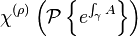
 represents the path-ordered operator.